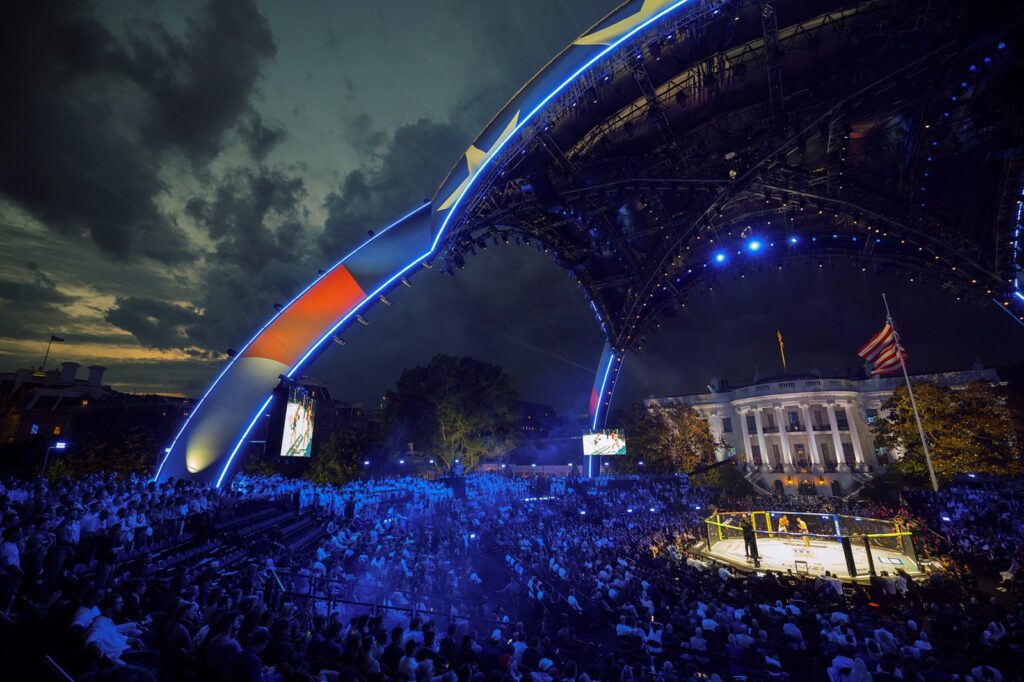
The Failed Plot Against the White House UFC Event
The UFC’s recent event at the White House served as a high-profile target for potential violence, drawing thousands to an open-air setting in the heart of Washington, D.C. As the event unfolded last weekend, the vulnerability of such a gathering—surrounded by elites and military personnel—was palpable in an era increasingly defined by political volatility.
A Foiled Conspiracy
Earlier this week, the FBI announced that it had successfully thwarted a plot targeting the UFC Freedom 250 event. The Justice Department has charged five individuals with various offenses related to the scheme, which allegedly involved the use of explosive-laden drones and coordinated sniper positions. While the event concluded without incident, Secret Service officials have indicated that the investigation remains active, suggesting that additional suspects may still be at large.
The government’s allegations detail a plan to utilize drones to deliver explosives while simultaneously targeting fleeing civilians with rifle fire. Experts in extremism, such as Joshua Fisher-Birch of the Counter Extremism Project, note that while mass shootings remain a persistent threat, the integration of drone technology into domestic terror plots represents a concerning evolution in lethality.
Motivations and Ideology
The investigation into the suspects, including 19-year-old Tycen Proper, has revealed a complex web of anti-government sentiment and extremist rhetoric. Court documents indicate that Proper had amassed significant weaponry and ammunition, with family members reporting his descent into radicalization, citing grievances ranging from government corruption to antisemitic conspiracy theories. Other alleged co-conspirators, including Bryan Roa, Michael Thomas, and Abraham Alvarez, were apprehended following search warrants executed by the DOJ.
Fisher-Birch observes that the ideology driving such groups is often a volatile mix of narratives. Antisemitism appears to be a unifying factor, frequently exacerbated by shifting foreign policy stances and conspiracy theories regarding national sovereignty. The rhetoric often targets the perceived failures of political leaders, with some extremists adopting labels like “Zion Don” to express their disillusionment with the current administration.
The Future of Domestic Threats
The failed plot underscores a broader, more dangerous trend in American politics. As social polarization deepens, the confluence of disparate conspiracy theories provides fertile ground for recruitment. The potential for domestic terror incidents involving consumer-grade drones is a reality that security agencies are increasingly forced to confront. As Fisher-Birch notes, the desire for increased lethality will continue to drive extremist groups toward new, more sophisticated tools. While this specific attempt was neutralized, the underlying conditions that foster such radicalization remain a significant challenge for national security.