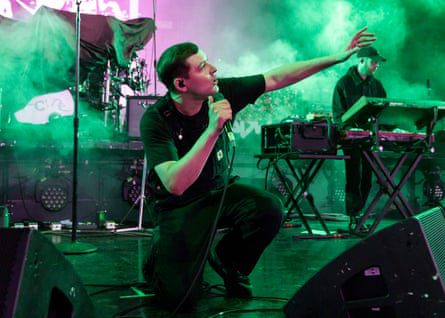
‘I woke up and couldn’t move’: Scottish rockers the Twilight Sad on births, death and breakdown
To say that James Graham has been through it in the seven years since the last Twilight Sad album would be an understatement. He lost his mother to dementia, became a father, and his own mental health struggles led to the band cancelling a tour with the Cure. The day we talk about the Scottish band’s sixth album, It’s the Long Goodbye, turns out to be the anniversary of his mum’s death. “It’s all right,” says Graham. “It seems like a good day to talk about it.”
Speaking from his home in north-east Scotland on a dark, murky evening, Graham is unflinchingly open about his experiences, often moved to tears as he recounts the last few years. “I was so ill at some points while I was writing these songs that it’s all quite hazy,” he says. “But the moments are coming back to me – of why I wrote a certain song. When I listen to one, I can feel it, ‘Fuck, you were really in it.’”
In every conceivable way, It’s the Long Goodbye is in it as Graham confronts his experiences head on. If you know the Twilight Sad, it’s nothing less than you’d expect – starting with 2007’s Fourteen Autumns & Fifteen Winters, they are a band who have always sounded as if they have lived every ounce of their songs. These are songs as therapy – about alienation and inner turmoil, rich in metaphor, with Graham’s evocative Scottish brogue capable of sounding tender and threatening against guitarist Andy MacFarlane’s turbulent guitar.
Yet the metaphors have been dropped for this record. The result is a visceral collection of tracks that act as a diary of Graham’s recent years. Lead single Waiting for the Phone Call sees him capture the dread of preparing to hear the worst over a propulsive, pummelling riff, then he’s “dealing with the dark again” in Attempt a Crash Landing – Theme. “And this time we’ll lose,” he sings, resigning himself over crashing guitars. The album’s title is drawn from his experience of watching someone he loved slowly disappearing before his eyes. “It’s seven years of saying goodbye so many times,” he says. “My mum lost her speech so quickly. It was like the worst horror film. I tried to find the glimmer of light when we were with each other, but …” His voice trails off.
“I’ve got two boys now. And Arthur was born very close to when my mum was diagnosed. So as he was developing, she was going down and, at one point, they kind of met in the middle. It was such a headfuck.”
As 2023 came to a close, his mother was in her final months, while the band were about to support the Cure in South America, after previous runs with them in Europe and North America. Graham reached breaking point. “One morning, I woke up and I couldn’t move. I just said, ‘I can’t do this.’” His voice breaks as he speaks. “I phoned our manager and the decision was taken out of my hands. I got an email from Robert right away, just saying, ‘None of this matters. Get better.’”
Robert is Robert Smith, the Cure’s singer, now known to Graham and MacFarlane as Rab. They’ve been almost inseparable since Smith asked the band to join the Cure on their world tour in 2016. It’s something Graham still can’t get to grips with. “Of all the bands,” he says, “I don’t know why he chose us.”
Smith finds it easier to explain. He tells me he “instantly fell in love with the attitude, the intensity, the emotion, the spirit, the tunes, the textures, the words and the voice” after Mogwai’s Stuart Braithwaite suggested he listen to Fourteen Autumns. “I bought every subsequent release and was pretty much a superfan when they asked me to cover a song in 2015.” This was There’s a Girl in the Corner. “I spent a lot of time with them on that first world tour. We became really good friends. Over the last 10 years, that friendship has blossomed and has become a very valuable thing to me.”
Recalling that 2016 tour, Graham says incredulously: “Some days it was just us and him backstage listening to music, having a laugh. And it was just like, ‘Can you believe this?’ He’s one of the best songwriters of all time, telling you that the songs you write are not just good, but that he loves them.”
Smith features on three tracks on It’s the Long Goodbye. But, says MacFarlane, speaking in a cafe in London the day after my chat with Graham, “he wasn’t just playing guitar, he was helping give advice with arrangements and stuff.” He remembers Smith giving them advice on the demos, too: “He reaches in his bag and pulls out a pad full of notes about every song. It was like getting a lecture off the teacher.”
Smith helped to fine-tune a record that had been developed over seven years by Graham and MacFarlane, now both 41 and the only remaining original members of the band. “I wrote when I could and felt like I had to,” Graham says, while MacFarlane focused on guitars rather than the icy synths they’ve also traded in. “It’s the yin and yang. There’s an energy and positivity to it, to go against the grain of the lyrics.”
“I really felt sorry for Andy,” says Graham, “The amount of shit he had to listen to. I did apologise to him quite a lot. But he’s also lost a parent so he was there for me.” MacFarlane, whose father died of cancer around the time the band started, recognised the effect of seeing “someone getting smaller. I understand the feeling of losing a parent and transferring it into music.”
As the band prepares to join the Cure on tour again this summer, there’s excitement but trepidation, too. Right now, Graham feels like a different person. His priorities have shifted, his world has changed. In the “tiny, wee village” he now calls home, “everybody just knows me as ‘Arthur and Norrie’s Dad’. It’s brilliant.” His children – the “one thing that got me up every morning” – are his focus and Graham says he’s “even more proud that I managed to still be there as a family member and a father than I am of this album”.
In retrospect, not playing that South American tour in 2023 seems like a pivotal moment. “It was due to start in November,” says Graham. “My mum died in the January. I know, to this day, that if I’d done that tour, it would have been a disaster. I was put on medication straight away. And it’s taken from that moment to the end of last year to really start to feel … I don’t want to say OK … But to start to feel a sense of happiness.”
His voice starts to crack again. “I’m so fed up of being back there,” he points with his hand. “I know what people think. James is miserable blah blah. And I know that’s part of me.” He pauses, takes a deep breath. “But I’m so ready to be happy.” The words hang in the air. “I’m ready to show people that you can go through that and get to the other side.” He laughs, quietly. “Look at me, I’m sitting here crying in front of you. But I am really excited about being given a second chance.” You can hear that hope on the new album’s closing track, TV People Still Throwing TVs at People, as Graham repeats the refrain: “It’s OK to feel this way.”
“That was me realising there’s no handbook that says this is how you’re going to feel,” he says. “I come from the central belt of Scotland, where men don’t talk about their feelings too much. And there’s an element, at the end of the record, where you’ve still got those doubts because you were told to push it down and get on with it. But in this, the most extreme circumstance, it’s like, ‘Why the fuck are we not talking about this?’”