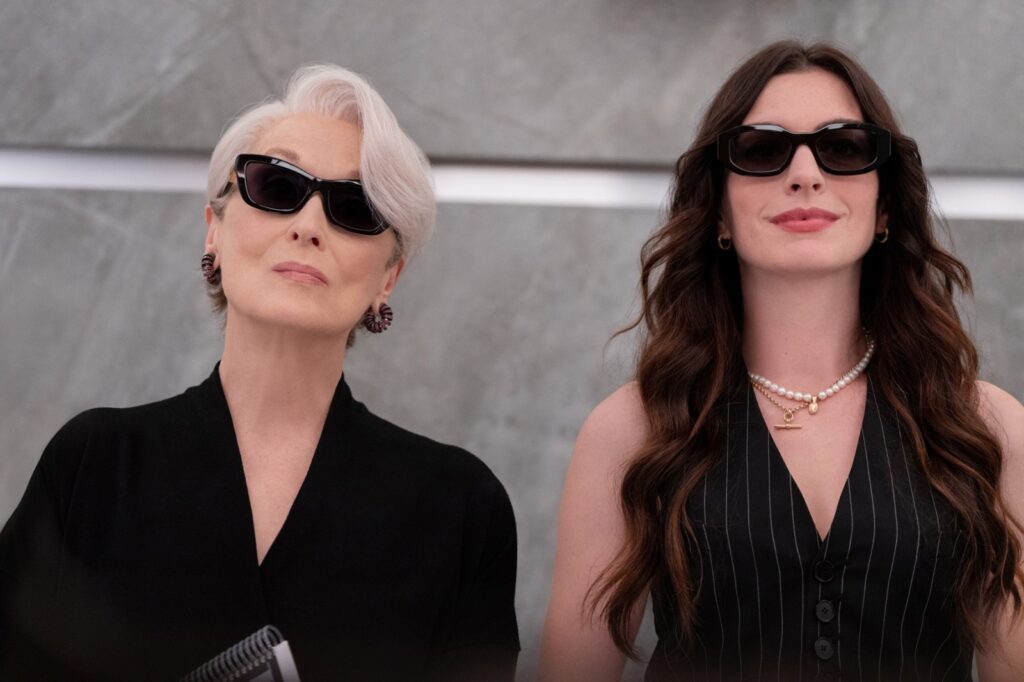
‘The Devil Wears Prada 2’ Dresses Up the Death of Journalism
A long time ago, in a Manhattan far, far away, a young commoner walked into a magical kingdom named Vogue and took a job as an assistant to Queen Wintour. She eventually escaped the clutches of her regal tormentor and wrote a roman à clef about her experiences. Names were changed, and the story was categorized as fiction, but everyone knew who the character of Miranda Priestly—with her Hermès scarf and sharp tongue—really was. Industry gossip and behind-the-curtain peeks have always been a potent literary currency.
It is worth remembering that Lauren Weisberger’s 2003 novel The Devil Wears Prada began as a form of literary payback. When the film adaptation arrived in 2006, the era of the celebrity editor-in-chief and the high-pressure, hostile workplace was in full swing. Even the nascent internet could not dim the allure of working at a major fashion magazine in the bustling New York publishing world. Poor Andy Sachs—portrayed by the wide-eyed Anne Hathaway—may have suffered the verbal lashings of a boss who expected whims to move worlds, but she also gained a major glow-up. And, of course, if you want to make your villain truly imperious, you cast Meryl Streep. There is a reason Miranda Priestly remains one of the Oscar-winner’s most beloved roles.
The Modern Reality of the Runway
The Devil Wears Prada 2 attempts to walk a fine line between delivering the fan-favorite elements—cattiness, couture, and the glory of a Stanley Tucci eyeroll—and acknowledging the harsh realities of 2026. In this version of the world, treating assistants like dirt is an H.R. violation, billionaires treat publishing houses like portfolio padding, and the craft of journalism has suffered an existential death by a thousand clicks.
Andy Sachs is now an award-winning investigative reporter, yet she and her team are still subject to the indignity of being fired via group text. Miranda Priestly continues to run Runway, but a scandal involving a puff piece on a toxic brand has left her vulnerable to a snarky meme tsunami. Budgets are slashed, and everyone is frantically chasing metrics. How is a Machiavelli in Manolo Blahniks expected to dictate taste in such a distasteful environment?
A Sequel Caught Between Eras
When Andy’s passionate acceptance speech at an NY Press Club event goes viral, Runway chairman Irv Ravitz offers her a job as the magazine’s features editor. Miranda, who barely remembers her former assistant, is less than thrilled. The narrative reunites the core cast, including Emily Blunt as the venomous fashion director Emily Charlton. While the film retains the zippy, comfort-food score of the original, it struggles to reconcile its nostalgia for the “good old days” of print media with the current, algorithm-driven reality.
The film introduces new players, including Lucy Liu as the socialite Sasha Barnes and Justin Theroux as her billionaire husband. While the performances are strong, the film’s refusal to engage with the digital realities of modern media—such as social media strategy or TikTok testimonials—makes it feel somewhat trapped in an idealized past.
Ultimately, The Devil Wears Prada 2 is a bittersweet experience. It offers the high-fashion wish-fulfillment audiences crave, but for those in the media industry, it serves as a horror movie dressed in couture. It is a reminder that integrity, talent, and hard work are in constant danger of extinction, even when the person delivering the news is wearing the latest designer collection.