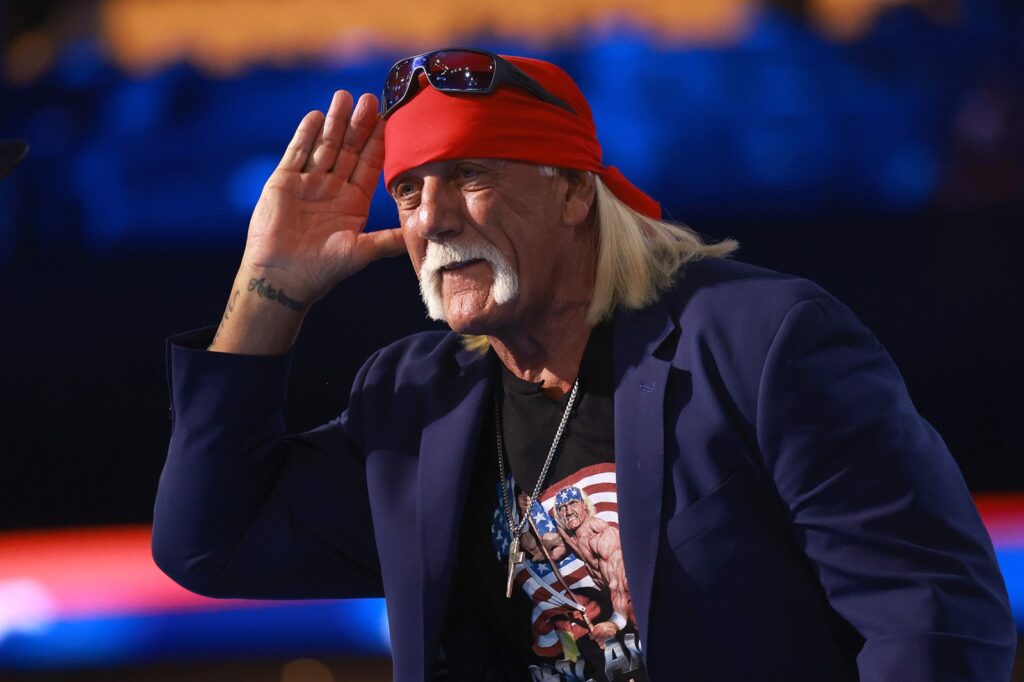
Hulk Hogan’s Final Interview: A Candid Look at His Struggle with Opioids
In his final interview recorded prior to his death, Hulk Hogan detailed his excessive consumption of fentanyl after launching his stint on Total Nonstop Action Wrestling in 2009. In the Netflix docuseries Hulk Hogan: Real American, the wrestling figure — who died at the age of 71 in July 2025 — recalled experiencing excessive pain during the program, which he attempted to remedy with opioids.
“I was taking 80-milligram fentanyls, two in the morning, stuffing them under my gums here,” Hogan said. “I had two 300mg patches of fentanyl on my legs and they gave me six 1500mg fentanyl lollipops to eat. I went to the pharmacy, he goes, ‘You should be dead. We have never seen a human being take this much fentanyl.’”
Eric Bischoff, a former wrestling executive, helped Hogan secure a contract with TNA Wrestling. Hogan had recently split from his wife, Linda Hogan, in a divorce that left him “broke.” He needed the money despite not being in the optimal condition to participate in such a physically demanding activity. In the docuseries, Bischoff attested to this. “Your wife’s divorcing you, your doctors are giving you fistfuls of pills that would kill a horse, and you’re chasing it down with a quart of vodka a day,” he said, noting that it was “hard to see” Hogan become so reliant on substances.
The divorce, which stemmed from Hogan’s extramarital affairs, left him without much of a support system, he suggested. Calls to his kids went unanswered and he relied on Bischoff for simple tasks. “I would literally have to go to his hotel and help him get out of bed and get into the shower to get ready to go to the shoot,” said Bischoff. Hogan recalled the pain being so intense that he could no longer sleep in his own bed. “I had to sleep in a chair,” he said, “and if I just twitched my finger like that, my whole back would spasm and torque.”
Hogan died from acute myocardial infarction, or a heart attack, after paramedics responded to a “cardiac arrest” call at his home in Clearwater, Florida. Medical records reportedly revealed that Hogan was previously diagnosed with atrial fibrillation — a heart condition defined as having an irregular heart rhythm — and chronic lymphocytic leukemia, a form of cancer.