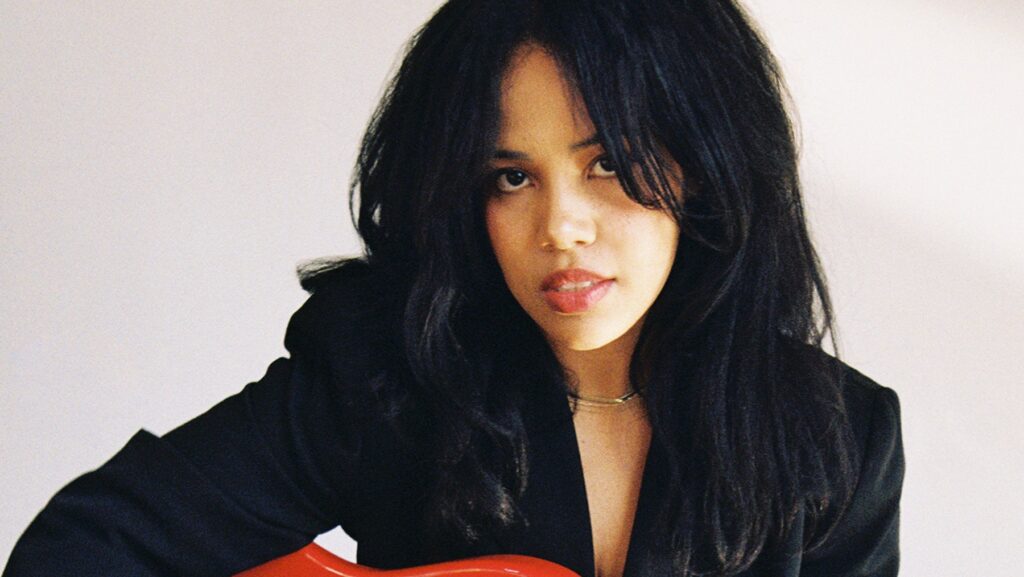
Baby Rose on ‘Yearnalism’ and Finding Her Own Voice
Baby Rose is currently playing arenas as an opening act for British pop phenomenon Olivia Dean, but a few days before starting that run, she still had one last thing to take care of. “I’m popping out for BadBadNotGood — they’re having a show on a boat,” she says when she logs onto Zoom from her L.A. home. The Toronto jazz band backed her on 2024’s sleepy yet soulfully crushing “One Last Dance,” and she was returning the favor. “The first day we met, I’m like, ‘Let me just throw them for a loop, let’s do a country song.’ I didn’t even have a chance to write it down. I was just emoting.”
She brought the same spontaneity to her latest album, Yearnalism. “Nine out of the 12 songs on this record were all done in the last 30 minutes to an hour of a session,” she recalls. “I was like, ‘Damn, that’s crazy.’ As far as the conception, the idea, and the writing of the song, the meat and potatoes, it was created in that last bit of time, where it’s like, ‘Let’s just try it one more time.’”
Embracing Intuition and Simplicity
Baby Rose, born Jasmine Rose Wilson, has always been in tune with her emotions. Astrologically, she’s a Cancer moon, which is said to reflect a person’s keen intuition and emotive nature. Yet, signs aside, Rose seems to be leaning more confidently into her true self-expression, both in her personal life and in her creative work. “There’s something to the uncertainty and surrender in my performance, that has that secret sauce in there,” she says. “I have more awareness of what’s going on in my creation process. I really understand the format of less is more, and simplicity is key, and following that gut feeling.”
Yearnalism started to come together last June in London alongside producer Miles C. James. While microdosing on shrooms, Rose and James listed intentions on a white board, from big concepts like God and the state of the world to more personal ideas about Rose’s individuality and her mother’s new home. Though they crafted the concept of six songs via voice memos, that first session wasn’t recorded. “He didn’t want to, and that was very hard for me to unlearn,” she says. “I’m always like, I’m leaving with something. I do really well under pressure, I can knock out something that I can play anywhere. But one of those songs, at the very last 30 minutes, was ‘Sunday.’”
Finding Balance and Self-Study
That nearly five-minute ballad sounds like a modern-day juke-joint hymn on a lazy Sabbath afternoon. Rose says the song was inspired by her mother’s sun room, an area of both refuge and rejuvenation. “The sun room in my mom’s house is like my ideal happy place. One of my greatest accomplishments with music is just being able to help her get that crib. Being in that sun room, going into that space, is where I feel like all of the problems just wash away, and I want the music to feel like that too.”
The album is filled with a mix of genres, giving nuance to Rose’s taste. Her opening track, “When I’m Gone,” is a blend of pop and soft rock, while her sultry and harmonic single “Friends Again,” featuring Leon Thomas — whom she collaborated with on Mutt, which won a Grammy for Best R&B Album — explores the complexities of intimacy between friends. Yet it’s “Better” that gets most clearly to the thesis of the project. This is not your average love song; it deals in all aspects of love’s stages and contradictions, such as desiring companionship while having the inner knowledge that the only way to truly fulfill that urge is to choose yourself.
At 31, Rose is at a stage in her life where she is doing “self-study.” When we last spoke, for her Rolling Stone Future 25 feature in 2023, she was fresh off the heels of her debut album. On her third project, she seems more focused in her grounding and internal habitat. “I’m realizing how important it is to be centered within,” she says. “I’ve done a lot of work on my own individual growth, and self-study. I’m trying to see where are the moments where I feel like I blame somebody else for making me feel a way, and how can I investigate that a little bit more.”
In creating Yearnalism, whose name was inspired by a meme about “majoring in yearnalism,” Rose wasn’t always quite sure of the direction in which she wanted to create. But like everything in her life, she learned to trust the process. “It gets better,” she says. “The people you meet along the way, almost like a game of Pokémon or the story of The Alchemist, whatever we are looking for is looking for us too.”