Phish’s Sphere Residency: A Masterclass in Improvisational Spectacle
It was during “Run Like an Antelope” when the giant guy in the Godsmack shirt behind me finally lost his composure. Those of us sitting near him at Night Three of Phish’s nine-show, three-weekend run at the Sphere in Las Vegas had seen the signs coming hours before: he was a newcomer, a metal enthusiast brought by a friend, yet entirely open-minded. By the break between sets, he was already captivated by the visuals—a journey through Phish history, an ode to their lighting designer, and a surreal narrative of a newborn chick flying into the world.
But during “Antelope,” as guitarist Trey Anastasio built a frenetic crescendo alongside keyboardist Page McConnell, drummer Jon Fishman, and bassist Mike Gordon, the man simply began to scream with pure, unadulterated joy. It is this specific phenomenon that keeps the Phish faithful returning for decades: the ability to bridge the gap between the uninitiated and the die-hard through sheer, improvisational energy.
The Sphere as an Instrument
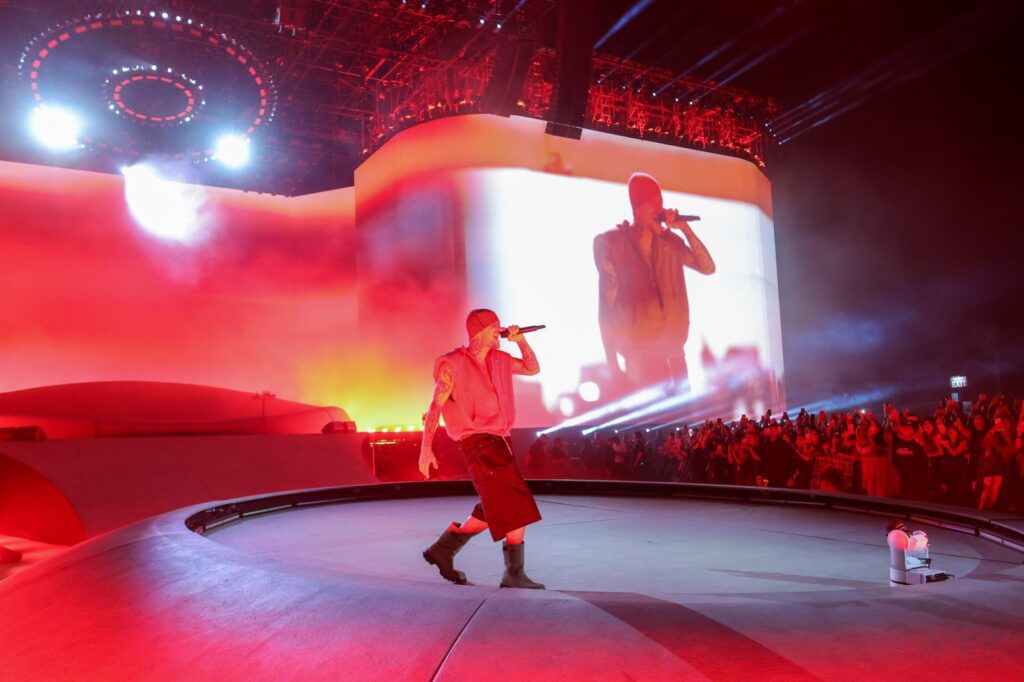
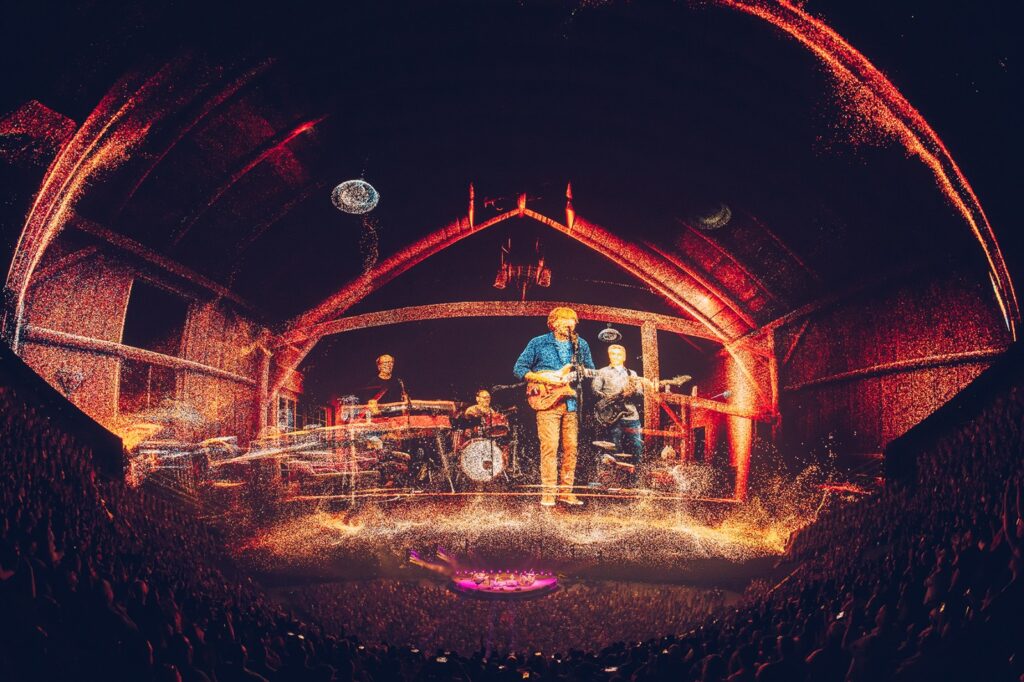
More than 40 years into their career, Phish remains one of rock’s most divisive yet enduring acts. While critics often point to the band’s penchant for long-form jams or their dedicated, tie-dye-clad fanbase, the reality of their Sphere residency is far more sophisticated. The $2.3 billion venue, with its 160,000-square-foot LED screen, was designed for precision-engineered spectacle. Most acts use it to deliver rigid, click-track-synced experiences. Phish, however, treats the Sphere as another instrument.
Instead of relying on pre-programmed sequences, the band maintained an improvisational core. Songs expanded and contracted, setlists shifted, and the visuals followed in real-time. This was most evident in their collaboration with legendary lighting director Chris Kuroda. Rather than using the Sphere to project abstract, pre-rendered graphics, they projected virtual, gravity-defying versions of Kuroda’s iconic lighting rig. Kuroda himself was at the console, improvising the light show in sync with the music, proving that human intuition remains the most powerful tool in live performance.
Surrealism and Spontaneity
The band’s signature surrealism was on full display throughout the residency. The opening night featured an animated suite that transitioned from a Vermont barn to a “Phish Hotel,” complete with a disco elevator and a weightless bowling alley. Later highlights included a hot-dog spaceship navigating constellations of chicken nuggets during “2001” and a windstorm of portalets sweeping through Paris during “Free.”
Yet, the most profound moments were often the simplest. During Night Three, a spontaneous decision to cover the James Gang’s “Walk Away” following an acknowledgment of Joe Walsh in the crowd provided a rare, intimate use of live-video montage. Similarly, the debut of Anastasio’s solo track “Brief Time” on Night Two—a stripped-back, visual-free performance—offered a poignant reminder of the band’s capacity for beauty, even four decades into their journey.
For those in the room, the message was clear: the capacity to create, to surprise, and to connect never fades. As Anastasio sang, “It’s such a beautiful world, and such a brief time.” It was a sentiment that resonated deeply, proving that even in the most high-tech environment on earth, the human element remains the true draw.